
Все

Фонокорректоры — Einstein Audio Components THE PHONOAMP
Описание, изображения, технические характеристики и спецификации
Einstein Audio Components THE PHONOAMP
Источник изображения — © Einstein Audio Components
The Phonoamp is a fully discrete MC phono amplifier that the Bochum firm Einstein Audio Components developed in 2016. Its maker describes it as a single transistor design with 48 individual transistors spread across three amplifier stages and no operational amplifiers anywhere in the signal path. Around 2020 it was listed at EUR 14,000, and it is offered as a single version for one tonearm or a double version for two, the latter holding four phono stage elements (2 x 2) and two identical power supply boards.
Key specs that matter
Gain is fixed at 68 dB, and the S/N ratio is above 82 dB at 1 mV and 1 kHz. Distortion is below 0.04% at 1 mV and 1 kHz, channel balance is within 0.3 dB, and all of these figures are measured without any feedback. Headroom is 12 dB, and the maximum input is 3.5 mV at 1 kHz. RIAA equalisation is passive. Output impedance is 60 ohm and the output swings up to 10 V RMS. Cartridge loading can be set to any value up to 2 kohm with resistor plugs. The phono unit and the power supply share a 215 x 360 x 150 mm housing size (H x D x W), with the single phono unit at 6 kg and the supply at 5.5 kg.
Engineering and use context
Ten field-effect transistors per channel form the input stage, the RIAA network is a two-stage passive arrangement of resistors and capacitors without inductors, and the final stage is built from discrete transistors with low output impedance and high current capability. Transistors are thermally coupled to lower noise. Feedback is avoided in every amplifier stage. Two Faraday cages provide shielding, and the two mono amplifiers inside the inner cage sit on a floating sub chassis mounted on rubber dampers to keep mechanical disturbance away from the signal. Each preamplifier module has 14,000 uF of supply decoupling. The external dual mono supply powers each channel separately and adds an input filter against mains interference, DC filtering with 10 x 2200 uF capacitors and electronic stabilisation with generous voltage reserves. With the channels galvanically separated, ground is established only at the connected amplifier, which prevents ground loops and crosstalk. The exterior combines polished stainless steel with black acrylic.
Pairing
Only moving-coil cartridges are supported, and since there is no gain switch Einstein states that the circuit is tuned for both low and higher output models. Connections are an RCA phono input and an RCA line output, with loading plugs also in RCA format on the rear panel. Einstein pairs it with the brand cartridge, tonearm and turntable.
Alternatives
The Einstein Phonostage mixes a discrete transistor input with op amp stages and offers two gain settings in place of a fixed value.
Key specs that matter
Gain is fixed at 68 dB, and the S/N ratio is above 82 dB at 1 mV and 1 kHz. Distortion is below 0.04% at 1 mV and 1 kHz, channel balance is within 0.3 dB, and all of these figures are measured without any feedback. Headroom is 12 dB, and the maximum input is 3.5 mV at 1 kHz. RIAA equalisation is passive. Output impedance is 60 ohm and the output swings up to 10 V RMS. Cartridge loading can be set to any value up to 2 kohm with resistor plugs. The phono unit and the power supply share a 215 x 360 x 150 mm housing size (H x D x W), with the single phono unit at 6 kg and the supply at 5.5 kg.
Engineering and use context
Ten field-effect transistors per channel form the input stage, the RIAA network is a two-stage passive arrangement of resistors and capacitors without inductors, and the final stage is built from discrete transistors with low output impedance and high current capability. Transistors are thermally coupled to lower noise. Feedback is avoided in every amplifier stage. Two Faraday cages provide shielding, and the two mono amplifiers inside the inner cage sit on a floating sub chassis mounted on rubber dampers to keep mechanical disturbance away from the signal. Each preamplifier module has 14,000 uF of supply decoupling. The external dual mono supply powers each channel separately and adds an input filter against mains interference, DC filtering with 10 x 2200 uF capacitors and electronic stabilisation with generous voltage reserves. With the channels galvanically separated, ground is established only at the connected amplifier, which prevents ground loops and crosstalk. The exterior combines polished stainless steel with black acrylic.
Pairing
Only moving-coil cartridges are supported, and since there is no gain switch Einstein states that the circuit is tuned for both low and higher output models. Connections are an RCA phono input and an RCA line output, with loading plugs also in RCA format on the rear panel. Einstein pairs it with the brand cartridge, tonearm and turntable.
Alternatives
The Einstein Phonostage mixes a discrete transistor input with op amp stages and offers two gain settings in place of a fixed value.
Характеристики
Название модели
THE PHONOAMP
Входы (балансные)
N/A
Входы (небалансные)
N/A
Входное сопротивление MC (по току) (Ω)
N/A
Входное сопротивление MM/MC (по напряжению) (Ω)
N/A
Выходное сопротивление (Ω)
60
Усиление (dB)
N/A
Точность кривых коррекции воспроизведения (dB)
N/A
Нижняя граница частотного диапазона +/- 3дБ (Hz)
N/A
Верхняя граница частотного диапазона +/- 3дБ (Hz)
N/A
Коэффициент гармонических искажений + шум (%)
< 0.04
Габариты (mm)
215 x 360 x 150
Вес (kg)
6
Официальная ссылка
Другие компоненты
Фонокорректоры
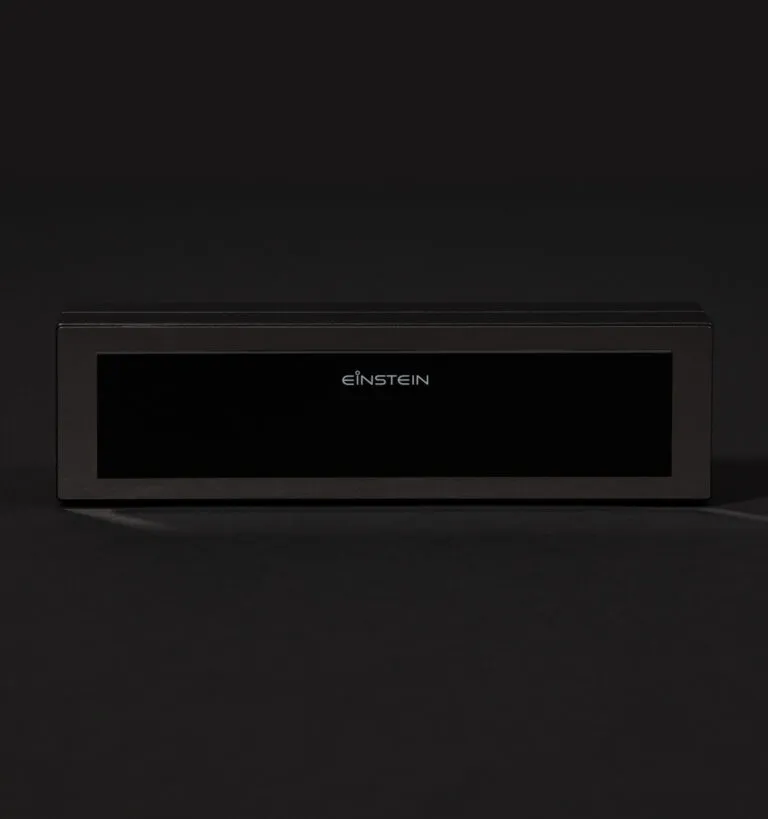
Einstein Audio Components THE PERFECT MATCH
Фонокорректоры
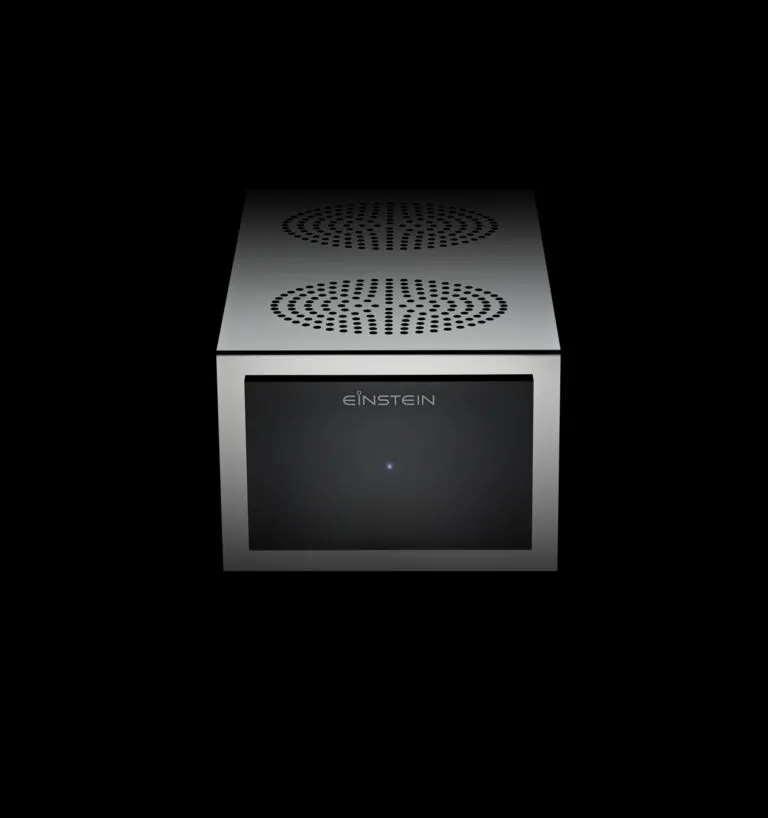
Einstein Audio Components THE PHONOSTAGE