Все

ЦАПы — Canor Audio Verto D4S
Описание, изображения, технические характеристики и спецификации
Canor Audio Verto D4S
Источник изображения — © Canor Audio
The Verto D4S is a solid-state digital-to-analogue converter in the Foundation Line from Canor of Presov, Slovakia. It is built in dual mono form around two ESS Sabre 9038Q2M chips, one for each channel, and follows them with a fully discrete, symmetrical analogue output stage built without any op-amps. Operation is through an 18 cm touch screen or a remote control that reaches every setting.
Key specs that matter
Over USB-C the converter takes PCM up to 24 bit and 768 kHz, DSD up to DSD256 over DoP and native DSD up to DSD512. AES/EBU, coaxial, two optical inputs and a dedicated TV input each handle PCM up to 24 bit and 192 kHz. Outputs are one RCA pair at 2 Vrms with 100 ohm impedance and one XLR pair at 4 Vrms with 200 ohm impedance. Frequency response runs from 20 Hz to 20 kHz within 0.1 dB. Measured at the XLR outputs, THD is under 0.0005%, the A-weighted noise ratio passes 112 dB and channel crosstalk stays under -127 dB. The case is 430 mm wide, 75 mm tall and 300 mm deep, or 305 mm with connectors, and weighs 8 kg.
Engineering and use context
Every digital input is galvanically isolated to block noise and ground interference from connected transports, players and televisions. From the remote the user can change filters, switch inputs and alter the display theme. The digital and analogue sections have independent linear regulation. The user chooses between eight digital filters. Canor's custom Optimal Transient filter bypasses internal oversampling for true non-oversampling operation, removing pre- and post-ringing. The display shows the active input, the sampling frequency, the chosen filter and the device status, and offers two colour themes. There are 12 V trigger jacks, one in and one out on 3.5 mm plugs, and firmware is updated over a wired connection. The casework combines aluminium, glass and steel and comes in black, silver or a new bronze finish. Power requirement is 230 V at 50 to 60 Hz and 30 VA.
Pairing
An amplifier or preamplifier with balanced sockets can take the 4 Vrms XLR feed, while any line input handles the RCA signal. The TV input lets a television share the converter with a streamer, CD transport or computer, and the trigger link allows it to start up together with an amplifier that has a matching trigger connection.
Alternatives
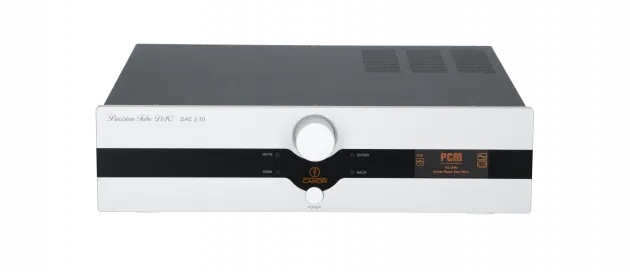
The Canor DAC 2.10 is a D/A converter with a tube-based analogue output, also using ES9038Q2M chips in dual mono.
Key specs that matter
Over USB-C the converter takes PCM up to 24 bit and 768 kHz, DSD up to DSD256 over DoP and native DSD up to DSD512. AES/EBU, coaxial, two optical inputs and a dedicated TV input each handle PCM up to 24 bit and 192 kHz. Outputs are one RCA pair at 2 Vrms with 100 ohm impedance and one XLR pair at 4 Vrms with 200 ohm impedance. Frequency response runs from 20 Hz to 20 kHz within 0.1 dB. Measured at the XLR outputs, THD is under 0.0005%, the A-weighted noise ratio passes 112 dB and channel crosstalk stays under -127 dB. The case is 430 mm wide, 75 mm tall and 300 mm deep, or 305 mm with connectors, and weighs 8 kg.
Engineering and use context
Every digital input is galvanically isolated to block noise and ground interference from connected transports, players and televisions. From the remote the user can change filters, switch inputs and alter the display theme. The digital and analogue sections have independent linear regulation. The user chooses between eight digital filters. Canor's custom Optimal Transient filter bypasses internal oversampling for true non-oversampling operation, removing pre- and post-ringing. The display shows the active input, the sampling frequency, the chosen filter and the device status, and offers two colour themes. There are 12 V trigger jacks, one in and one out on 3.5 mm plugs, and firmware is updated over a wired connection. The casework combines aluminium, glass and steel and comes in black, silver or a new bronze finish. Power requirement is 230 V at 50 to 60 Hz and 30 VA.
Pairing
An amplifier or preamplifier with balanced sockets can take the 4 Vrms XLR feed, while any line input handles the RCA signal. The TV input lets a television share the converter with a streamer, CD transport or computer, and the trigger link allows it to start up together with an amplifier that has a matching trigger connection.
Alternatives
The Canor DAC 2.10 is a D/A converter with a tube-based analogue output, also using ES9038Q2M chips in dual mono.
Характеристики
Название модели
Verto D4S
Тип преобразования
N/A
Чип преобразования
2 x ESS9038Q2M
Совместимость с DSD
Да
Параметры
up to 24-bit / 768 kHz and DSD512
Нижняя граница частотного диапазона +/- 3дБ (Hz)
20
Верхняя граница частотного диапазона +/- 3дБ (Hz)
20 000
Усиление (dBu)
N/A
Уровень выхода (балансный) (V)
4
Уровень выхода (небалансный) (V)
2
Входное сопротивление (балансное) (Ω)
N/A
Входное сопротивление (небалансное) (Ω)
N/A
Выходное сопротивление (балансное) (Ω)
200
Выходное сопротивление (небалансное) (Ω)
100
Аналоговые выходы
N/A
Отношение сигнал/шум (dB)
> 112
Коэффициент гармонических искажений + шум (% at 22 kHz)
< 0.0005
Габариты (mm)
430 x 75 x 300
Вес (kg)
8
Официальная ссылка