
Все

Усилители для наушников — Concert Fidelity Charisma XHP-7
Описание, изображения, технические характеристики и спецификации
Concert Fidelity Charisma XHP-7
Источник изображения — © Concert Fidelity
The Charisma XHP-7 is the model Concert Fidelity calls its headphone monitoring reference amplifier, and it is listed as the audiophile reference in the Charisma XHP headphone range, next to the XHP-4 desktop reference and the XHP-5 studio reference. The Japanese firm behind it was founded in 1987 by designer Masataka Tsuda and remains a one-man build operation in Nagano, so each chassis is assembled by hand. The company does not publish a retail price and directs enquiries to its distributors.
Key specs that matter
Four line-level RCA inputs are provided, and the fourth input also has an XLR socket for balanced sources. Input impedance is 100 kohm on the RCA connections and 50 kohm on the XLR. Inside are two separate headphone amplifiers, each with its own output level control and mute, so two listeners can use the unit at once at different volumes. Each of the two output groups offers a 1/4 inch TRS jack plus either a four-pin XLR or a pair of three-pin XLR connectors for left and right. The amplifier circuit is Class AB in a BTL arrangement, and the recommended headphone load spans 6 ohm to 600 ohm. Mains versions exist for 100 V, 110 to 120 V, 220 to 230 V and 240 V supplies. The chassis is 450 mm wide, 100 mm high and 310 mm deep, and it weighs 8.5 kg.
Engineering and use context
Concert Fidelity states that the output section can be built to the customer's own specification. The three-pin XLR pair can be wired either unbalanced or balanced, which lets the XHP-7 accept headphone leads terminated in split left and right XLR plugs as well as the single four-pin plug. Because the amplifier uses a bridged output stage, the balanced sockets carry separate positive and negative drive for each channel. The unit is supplied with a transformer made for the destination country, the maker accepts no responsibility for running it on a different supply. Repairs for failures that happen abroad are excluded from cover. The case has the same footprint the brand uses for its CF-080LSX line stage, its DAC-040Mk2 converter and the CDV-2 crossover, so the XHP-7 matches them in width and depth. As with its other designs, Tsuda's stated aim is a circuit with the fewest possible parts in the signal path.
Pairing
With four inputs, the XHP-7 can take a DAC, a phono stage output, a tape deck and one balanced source without a separate preamplifier. The low lower limit of the load range admits low-impedance headphones, and the dual output groups suit studio use where an engineer and a client monitor the same programme.
Alternatives
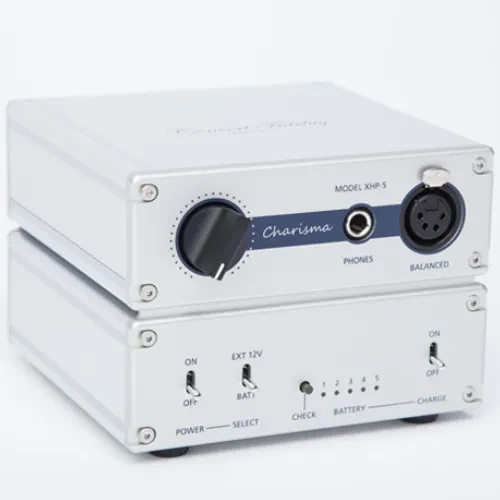
The Charisma XHP-5 is the compact battery-powered option from the same range, with a single RCA input and one headphone amplifier in a 132 mm wide case.
Key specs that matter
Four line-level RCA inputs are provided, and the fourth input also has an XLR socket for balanced sources. Input impedance is 100 kohm on the RCA connections and 50 kohm on the XLR. Inside are two separate headphone amplifiers, each with its own output level control and mute, so two listeners can use the unit at once at different volumes. Each of the two output groups offers a 1/4 inch TRS jack plus either a four-pin XLR or a pair of three-pin XLR connectors for left and right. The amplifier circuit is Class AB in a BTL arrangement, and the recommended headphone load spans 6 ohm to 600 ohm. Mains versions exist for 100 V, 110 to 120 V, 220 to 230 V and 240 V supplies. The chassis is 450 mm wide, 100 mm high and 310 mm deep, and it weighs 8.5 kg.
Engineering and use context
Concert Fidelity states that the output section can be built to the customer's own specification. The three-pin XLR pair can be wired either unbalanced or balanced, which lets the XHP-7 accept headphone leads terminated in split left and right XLR plugs as well as the single four-pin plug. Because the amplifier uses a bridged output stage, the balanced sockets carry separate positive and negative drive for each channel. The unit is supplied with a transformer made for the destination country, the maker accepts no responsibility for running it on a different supply. Repairs for failures that happen abroad are excluded from cover. The case has the same footprint the brand uses for its CF-080LSX line stage, its DAC-040Mk2 converter and the CDV-2 crossover, so the XHP-7 matches them in width and depth. As with its other designs, Tsuda's stated aim is a circuit with the fewest possible parts in the signal path.
Pairing
With four inputs, the XHP-7 can take a DAC, a phono stage output, a tape deck and one balanced source without a separate preamplifier. The low lower limit of the load range admits low-impedance headphones, and the dual output groups suit studio use where an engineer and a client monitor the same programme.
Alternatives
The Charisma XHP-5 is the compact battery-powered option from the same range, with a single RCA input and one headphone amplifier in a 132 mm wide case.
Характеристики
Название модели
Charisma XHP-7
Максимальная мощность, 32 Ом (mW RMS per channel)
N/A
Максимальная мощность, 50 Ом (mW RMS per channel)
N/A
Максимальная мощность, 300 Ом (mW RMS per channel)
N/A
Максимальная мощность, 600 Ом (mW RMS per channel)
N/A
Нижняя граница частотного диапазона +/- 3дБ (Hz)
N/A
Верхняя граница частотного диапазона +/- 3дБ (Hz)
N/A
Усиление (dBu)
N/A
Коэффициент гармонических искажений (THD) (% at 1V RMS, 300 ohms)
N/A
Отношение сигнал/шум (dB)
N/A
Интермодуляционные искажения (IMD) (%, CCIR, 300 Ohms)
N/A
Переходное затухание между каналами (dB, 20Hz-20KHz, 300 Ohms)
N/A
Выходное сопротивление (Ohms)
N/A
Габариты (mm)
450 x 100 x 310
Вес (kg)
8.5
Официальная ссылка
Другие компоненты
Усилители для наушников
Concert Fidelity Charisma XHP-5