

Предусилители — Boulder 1110
Описание, изображения, технические характеристики и спецификации
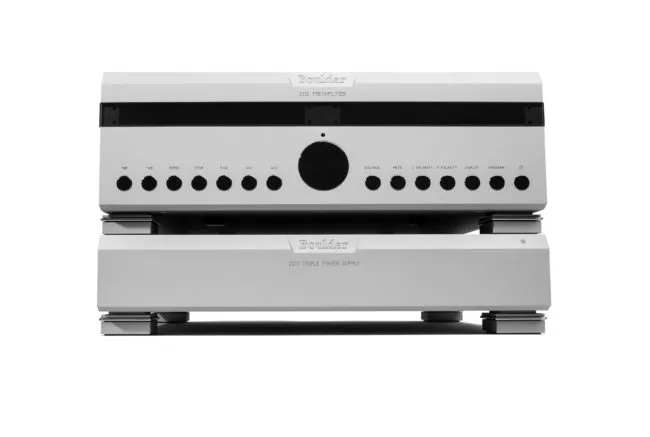
Boulder 1110
Источник изображения — © Boulder
Key specs that matter
Connections comprise five pairs of programmable, differentially balanced inputs, two pairs of balanced main outputs and one pair of balanced auxiliary outputs. Maximum voltage gain is 20 dB, and the auxiliary path gives 8.5 dB balanced or 2.5 dB unbalanced. Volume covers a 100 dB range in 0.5 dB steps or 1.0 dB steps. The input accepts up to 6.0 Vrms and the output can swing 14.0 Vrms. THD+N at 2 V output across 20 Hz to 20 kHz is 0.0015% (-96.5 dB), with less than 1 dB of distortion change into a 150 ohm load. Response is flat within 0.03 dB over the audio band and falls 3 dB at 0.02 Hz and 250 kHz. Clip to noise ratio is 118 dB, and crosstalk is -101 dB between channels and -115 dB between adjacent inputs. Input impedance is 100 kOhm balanced or 50 kOhm unbalanced, and output impedance is 100 ohms balanced or 50 ohms unbalanced. The unit weighs 16.3 kg and draws at most 75 W.
Engineering and use context
Although it uses one enclosure, the 1110 splits its circuitry into ten separate subassemblies - left and right input, left and right analog, ARM processor supervision and logic, display, analog transformer, digital transformer, supply regulation and standby supply - so that the analog stages stay isolated from control and power supply noise. Dual-mono audio boards keep the channels apart. The volume control is a balanced version of the design from the 3010, and Boulder's 985 gain stage provides the output current needed to drive long cable runs. Circuit boards are built with surface-mount parts on the company's own pick-and-place machine. An ARM processor runs every function, and a colour LCD shows input name, volume, trims, balance and polarity. Settings can also be reached from a browser through the HTML programming page, and software updates are downloaded automatically online.
Pairing
Each input can be set to Theater Mode for fixed-gain use with a surround processor. Control options include Ethernet IP, infrared and Boulder Net, which suits home automation systems. The 1151 Mono Power Amplifier shares the width and depth of this chassis, and mains versions exist for 100, 120 and 220-240 V.
Alternatives
The Boulder 2110 Preamplifier uses four separate chassis, six balanced inputs and volume steps as fine as 0.1 dB.
Характеристики
Название модели
1110
Аналоговые входы (балансные)
5
Аналоговые входы (небалансные)
N/A
Аналоговые выходы (балансные)
3
Аналоговые выходы (небалансные)
N/A
Усиление (dBu)
20
Чувствительность входа (mV)
N/A
Выходное напряжение (V)
N/A
Входное сопротивление (балансное) (Ω)
100 000
Входное сопротивление (небалансное) (Ω)
N/A
Выходное сопротивление (балансное) (Ω)
100
Выходное сопротивление (небалансное) (Ω)
N/A
Максимальный уровень выхода (балансный) (dBu)
14
Максимальный уровень выхода (небалансный) (dBu)
N/A
Диапазон регулировки громкости (dBu)
N/A
Нижняя граница частотного диапазона +/- 3дБ (Hz)
0.02
Верхняя граница частотного диапазона +/- 3дБ (Hz)
250 000
Отношение сигнал/шум (SNR, невзвешенное) (dB)
118
Коэффициент гармонических искажений + шум (THD+N) (%)
0.0015% (-96.5 dB)
Габариты (mm)
N/A
Вес (kg)
16.3
Официальная ссылка
Другие компоненты
Предусилители
Boulder 2110
Предусилители
Boulder 3010