

Усилители мощности моно — Soulnote M-3
Описание, изображения, технические характеристики и спецификации
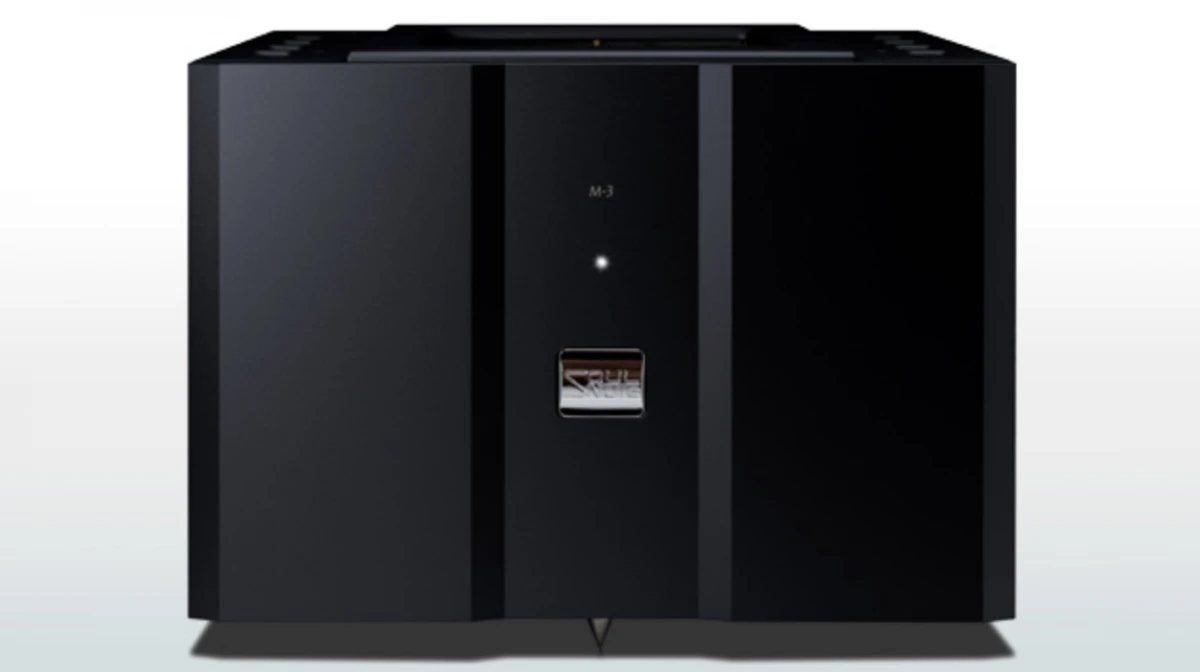
Soulnote M-3
Источник изображения — © Soulnote
Key specs that matter
Maximum output is 160 W into 4 ohm. Distortion is 0.1% at 1 W and the response extends from 2 Hz to 200 kHz within 1 dB. Input sensitivity is 2 V with an input impedance of 25 kohm, and gain is 22 dB. Consumption is 110 W at full load and 36 W with no signal, from a 230 V 50 Hz supply in the European version. The chassis measures 340 x 257 x 512 mm and weighs 31 kg. A special speaker cable, a dedicated rack, a power cable and a setting plate come in the box.
Engineering and use context
Soulnote holds that a single push-pull output avoids blurring in the time domain, but such a stage usually offers limited current, so the M-3 uses large can transistors driven through four Darlington stages. The driver stage uses the output transistors of the Soulnote A-2 integrated amplifier. Small copper plate heat sinks double as bus bars that power the output devices, whose leads pass through them straight to the board, so no wiring or insulating sheets sit between transistor and circuit. The heat sinks are also isolated from the chassis. Voltage gain comes from a new Type-R circuit of four bipolar transistors and ten resistors, a topology Soulnote compares to single-ended valve amplifiers. There is one XLR input and one pair of speaker terminals, no selector, no attenuator and no microcontroller - the power switch is the only control. Power comes from a 1600 VA toroidal transformer without epoxy filling, mounted upright on the front panel so leakage flux runs parallel to the boards and hung on titanium washers above a spike. Filtering uses 470 uF foil capacitors in parallel, and rectification uses SiC diodes. The amplifier section is housed in a container physically apart from the main body, and each rests on three spikes, six in total.
Pairing
With only a balanced input and no level control, the M-3 has to be driven by a line stage that has balanced outputs, for example the Soulnote P-3. Two units are required for stereo, and its fixed gain sets how much output the preamplifier must deliver to reach full power.
Alternatives
The Soulnote M-3X is the other monoblock in the range, pairing two matched can transistors per side for 240 W into 2.7 ohm in the same case size.
Характеристики
Название модели
M-3
Чувствительность входа (mV)
2000
Входное сопротивление (балансное) (Ω)
25 000
Входное сопротивление (небалансное) (Ω)
N/A
Выходное сопротивление (балансное) (Ω)
N/A
Выходное сопротивление (небалансное) (Ω)
N/A
Максимальный ток (A)
N/A
Выходная мощность (8Ω) (W)
N/A
Выходная мощность (4Ω) (W)
160
Усиление (dBu)
22
Нижняя граница частотного диапазона +/- 3дБ (Hz)
2
Верхняя граница частотного диапазона +/- 3дБ (Hz)
200 000
Отношение сигнал/шум (dB)
N/A
Коэффициент гармонических искажений + шум (0% обратной связи) (%)
N/A
Коэффициент гармонических искажений + шум (100% обратной связи) (%)
0.1
Максимальное энергопотребление (W)
110
Коэффициент демпфирования
N/A
Габариты (mm)
340 × 257 × 512
Вес (kg)
31
Официальная ссылка
Другие компоненты
Усилители мощности моно
Soulnote M-3X