

Усилители мощности моно — Boulder 1151
Описание, изображения, технические характеристики и спецификации
Boulder 1151
Источник изображения — © Boulder
Key specs that matter
Continuous output is 250 W into 8, 4 and 2 ohms alike. Peak output is 350 W into 8 ohms, 600 W into 4 ohms and 750 W into 2 ohms. At 250 W distortion is 0.002%, rising to 0.01% at 20 kHz into 8 or 4 ohms, and into 2 ohms the figures are 0.003% and 0.02%. Signal to noise is -108 dB over 10 to 80 kHz, and equivalent input noise is 2.2 microvolts. Response is flat within 0.04 dB from 20 Hz to 20 kHz and falls 3 dB at 0.015 Hz and 150 kHz. Voltage gain is 26 dB. Input impedance is 200 kOhm balanced or 100 kOhm unbalanced, and common mode rejection reaches 90 dB at 60 Hz and 65 dB at 10 kHz. Each amplifier weighs 24.5 kg, and power draw is 10 W in standby, 60 W at idle and 800 W at full output.
Engineering and use context
Boulder biases the output section with its Class-A Smart Current scheme. An analog circuit monitors the current the speaker draws and adjusts bias continuously as the load impedance changes with frequency, which removes crossover distortion at the polarity transition without the heat of a fixed Class A design. Each chassis holds 40 output transistors and 12 supply capacitors, using many smaller capacitors instead of a few large ones, and a pair of 1151 amplifiers has more output devices than one 1162 stereo amplifier. The signal path has two stages, with the first providing most of the voltage gain so the output section can concentrate on current delivery. Protection circuitry shuts the output down at once if speaker cables short or a system fault appears. Heat sinks are machined from solid aluminium billet, the feet use constrained layer damping, and the front panel reproduces a topographical map of Flagstaff Mountain near Boulder.
Pairing
The input is a 3-pin balanced XLR, so a balanced preamplifier such as the Boulder 1110 is the obvious source. Two sets of 6 mm wingscrew terminals accept bi-wired loudspeakers, and mains versions exist for 100, 110-120 and 220-240 V supplies.
Alternatives
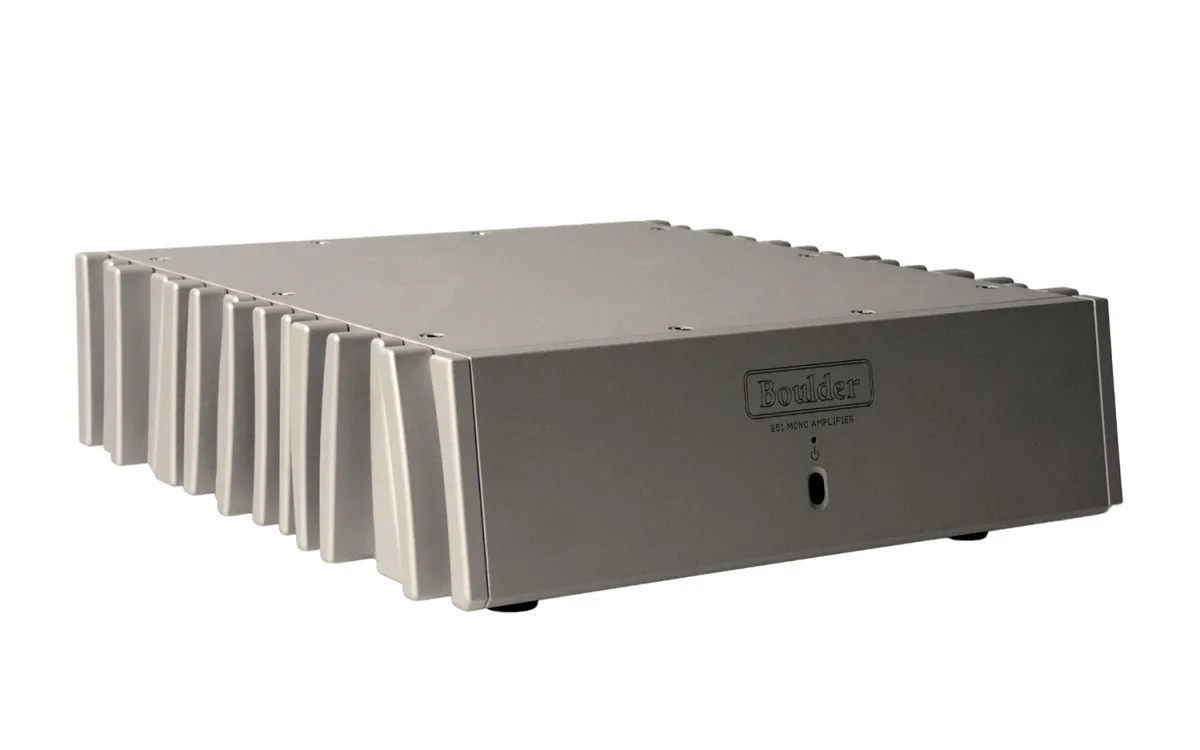
The Boulder 851 Mono Power Amp is the smaller 800 Series monoblock, built around its own Smart Current output stage.
Характеристики
Название модели
1151
Чувствительность входа (mV)
N/A
Входное сопротивление (балансное) (Ω)
200 000
Входное сопротивление (небалансное) (Ω)
100 000
Выходное сопротивление (балансное) (Ω)
N/A
Выходное сопротивление (небалансное) (Ω)
N/A
Максимальный ток (A)
N/A
Выходная мощность (8Ω) (W)
350
Выходная мощность (4Ω) (W)
600
Усиление (dBu)
26
Нижняя граница частотного диапазона +/- 3дБ (Hz)
0.015
Верхняя граница частотного диапазона +/- 3дБ (Hz)
150 000
Отношение сигнал/шум (dB)
N/A
Коэффициент гармонических искажений + шум (0% обратной связи) (%)
N/A
Коэффициент гармонических искажений + шум (100% обратной связи) (%)
0.002%, 20kHz 0.01% (8 Ohms)
Максимальное энергопотребление (W)
N/A
Коэффициент демпфирования
N/A
Габариты (mm)
N/A
Вес (kg)
24.5
Официальная ссылка
Связанные материалы
Другие компоненты
Усилители мощности моно
Boulder 851
Усилители мощности моно
Boulder 2150
Усилители мощности моно
Boulder 3050