

Интегральные усилители — Audio Note Jinro
Описание, изображения, технические характеристики и спецификации
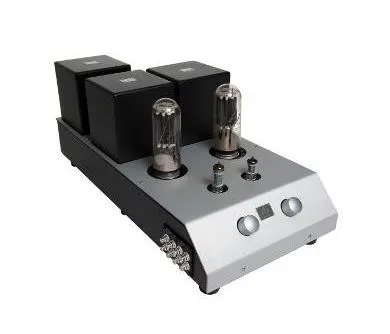
Audio Note Jinro
Источник изображения — © Audio Note
Key specs that matter
Output is about 20 W per channel into 4 or 8 ohms from one 211 per channel in pure Class A. There are four single-ended RCA line inputs. Input sensitivity is 450 mV and input impedance is 100 kohm. The rectifiers are two 5R4WGB valves, and the input and driver stages use ECC82 or 5814A and 7044 or 5687 valves. Channel balance is within 0.3 dB, and the mains input accepts 100 to 120 V or 220 to 240 V at 50 or 60 Hz. Power consumption is about 200 W. The chassis is 305 mm high, 305 mm wide and 640 mm deep, and weighs about 38 kg, largely due to its transformers.
Engineering and use context
The Jinro meets all Audio Note Level 3 criteria. The criteria require Class A bias throughout, no global feedback, one output valve per channel, a valve rectifier, a directly heated triode and a set grade of parts. The 211 is a large transmitting triode, capable of more power than the 300B used in many single-ended designs. The output stage is single ended, meaning a lone 211 handles both halves of each cycle, and the resulting distortion is mostly second order. The driver stage is coupled through an interstage transformer made by Audio Note, wound in copper on a double C-core with HiB laminations at a 1 to 2 ratio. The output transformers and the mains transformer use the same core type. Resistors are Beyschlag parts to Level 3 standards. Audio Note also designs its own 211 valve, the 4242E, which can be fitted. Top plates are natural or black anodised aluminium. Measured signal-to-noise ratio is about 44 to 62 dB unweighted, typical of a single-ended 211 design without feedback. The Jinro uses the same brand of 211 valves as the Ongaku.
Pairing
With modest power and no feedback, the Jinro needs sensitive speakers with an easy load, ideally 92 dB or more, such as Audio Note's own models. Its four line inputs connect CD players, DACs and an external phono stage.
Alternatives
Audio Note's Ongaku is the silver-wired 211 integrated amplifier on which the Jinro circuit is based.
Характеристики
Название модели
Jinro
Тип
Integrated Amplifier
Аналоговые входы (балансные)
N/A
Аналоговые входы (небалансные)
4
Чувствительность входа (mV)
450
Входное сопротивление (балансное) (Ω)
N/A
Входное сопротивление (небалансное) (Ω)
100 000
Выходное сопротивление (балансное) (Ω)
N/A
Выходное сопротивление (небалансное) (Ω)
N/A
Цифро-аналоговое преобразование
Н/д
Входное сопротивление Phono MM/MC (по току) (Ω)
N/A
Выходная мощность (8Ω) (W)
20
Выходная мощность (4Ω) (W)
20
Усиление (dBu)
N/A
Нижняя граница частотного диапазона +/- 3дБ (Hz)
N/A
Верхняя граница частотного диапазона +/- 3дБ (Hz)
N/A
Отношение сигнал/шум (dB)
N/A
Коэффициент гармонических искажений + шум (%)
N/A
Коэффициент демпфирования
N/A
Габариты (mm)
305 x 305 x 640
Вес (kg)
38
Официальная ссылка
Другие компоненты
Интегральные усилители
Audio Note Meishu Tonmeister Line
Интегральные усилители
Audio Note Meishu Phono 300B Tonmeister
Интегральные усилители
Audio Note OTO SE 35
Интегральные усилители
Audio Note Ongaku
Интегральные усилители
Audio Note Tomei