
Alle

Tonarme - Reed Reed 1H 10.5"
Beschreibung, Bilder, technische Daten und Spezifikationen
Reed Reed 1H 10.5"
Bildquelle - (c) Reed
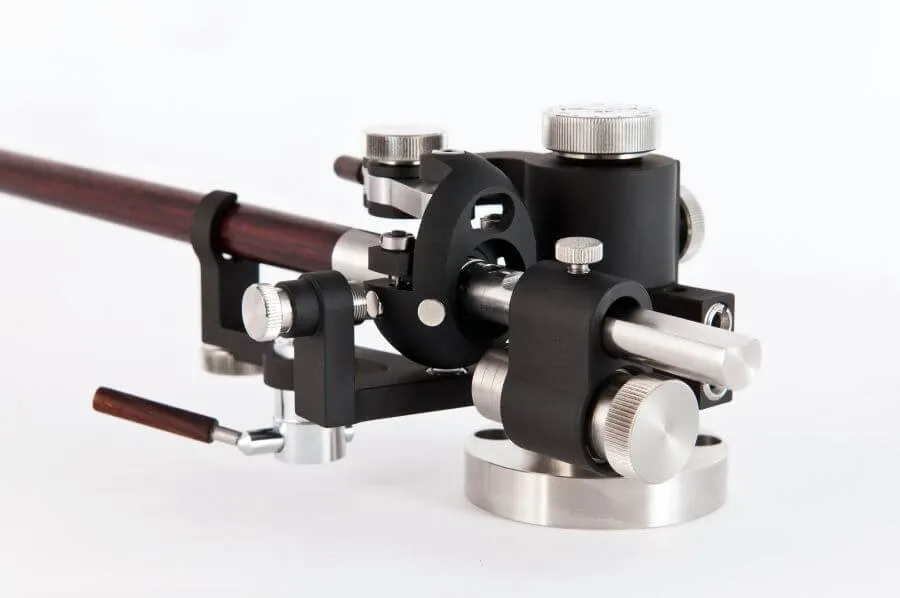
The Reed 1H is a tonearm from Reed of Lithuania, shown here in its middle length with 251.6 mm between pivot and spindle. Reed calls it the latest addition to its entry level tonearm series, and it is the first Reed arm with carbon fiber as the primary armwand material. Vidmantas Triukas started the company in 2007. A radio engineer working in hi-fi since 1985, he researched the transmission of acoustic noise in different materials and holds three patented inventions in that field. US prices for the 1H start at USD 5,195, and custom builds take three to four weeks. In the UK the shortest 1H is listed at GBP 3,098 with a 2-year warranty.
Key specs that matter
Mounting distance and pivot to spindle distance are both 251.6 mm. Overhang is 15.4 mm, and the offset angle is 20.7 degrees. Approximate effective mass is 15 g, against 12 g for the shortest 1H and 18 g for the longest. Height adjustment range is 28 - 48 mm. Signal output is either a 5-pin DIN connector or Finewire 37 cables. Two finishes are listed, Seashell White and Black.
Engineering and use context
Carbon fiber is not used on its own in this armwand. Reed damps the carbon fiber tube with soft wood, and after its research the company states that the acoustic properties of the damped wand come close to those typical of wood and can be compared with its wooden armwands. It publishes measurements of a damped and an undamped carbon fiber wand side by side.
Its bearing is a cardanic system. Thrust rotation bearings sit on the vertical axis, and the horizontal axis is based on thrust pivot bearings, the same concept as in the Reed 3P. According to Reed, this construction eliminates bearing wobble. Anti-skating is magnetic and similar to the one in the 3P.
Azimuth and VTA are adjustable, and the headshell is replaceable. Two more lengths complete the 1H family, with mounting distances of 223 mm and 295.6 mm, overhangs of 17 mm and 13.4 mm and offset angles of 22.9 and 17.6 degrees.
Pairing
The arm mounts on most turntables out of the box, and an adapter is used where the armboard does not match. With the DIN version a phono cable with a 5-pin DIN plug is required. A phono stage with an input for the chosen cartridge is required.
Alternatives
The Reed 2B is a higher Reed tonearm, with low-friction ceramic bearings, wooden armwands and anti-skating set separately for the start and the end of the record.
Spezifikationen
Modellbezeichnung
Reed 1H 10.5"
Typ
Gimbal
Effektive Masse (g)
N/A
Effektive Länge (mm)
267
Einstellbereich Kanalbalance (g)
N/A
Überhangwinkel (deg)
20.7
Überhang (mm)
15.4
Gewicht (g)
N/A
Offizieller Link
Weitere Komponenten
Tonarme
Reed REED 5T
Tonarme
Reed REED 2G 9.5"
Tonarme
Reed REED 2G 10.5"
Tonarme
Reed REED 2G 12"
Tonarme
Reed Reed 3P 9.5"