
Alle

Kopfhörerverstärker - Schiit Audio VALHALLA 3
Beschreibung, Bilder, technische Daten und Spezifikationen
Schiit Audio VALHALLA 3
Bildquelle - (c) Schiit Audio
The Valhalla 3 is the third version of the all-tube headphone amplifier from Schiit Audio, listed at USD 499. Schiit introduced the first Valhalla in 2010 as its second product and calls the new model a fully modern tube headphone amp, with an OTL/OCL topology and no transformer or capacitors between the tubes and the headphones. Folkvangr, an earlier 10-tube special edition amplifier, was the proving ground, and only the tube complement is carried over from the Valhalla 2. Assembly is in San Antonio, Texas, and the 5-year limited warranty excludes tubes, which have a 90-day warranty.
Key specs that matter
Maximum power is 750 mW RMS per channel into 32 ohms with the impedance multiplier and 250 mW into 300 ohms without it, both rated at 10% THD. THD+N is below 0.05% in low gain and below 0.2% in high gain, at 1 V RMS into 300 ohms. SNR is above 110 dB in low gain and above 95 dB in high gain (A-weighted, ref. 2 V RMS). Crosstalk is below -75 dB (20 Hz - 20 kHz, 300 ohms), and frequency response is 20 Hz - 20 kHz (±0.05 dB). Gain is 1.25x, 6x or 10x, with output impedance of 25, 40 and 60 ohms in the low gain, high gain and no-feedback settings. Input impedance is 50 kohms. Size is 229 x 152 x 51 mm without tubes (about 83 mm high with them), and weight is 3.2 kg.
Engineering and use context
Its circuit is all-triode and noninverting, with a single voltage gain stage, a current-source biased front end and a WCF output stage, DC coupled at the input and from the tube output. Each channel uses one 6N1P dual triode at the input and one 6N6P dual triode at the output. Input tubes can be replaced with 6DJ8, E88CC, 6922, 6BZ7 and similar types, provided total heater current stays under 2.7 A. Inside, the 100% linear supply has a 48 VA transformer, a discrete regulated 200 V tube rail, ±100 V output rails with capacitance multipliers and ±12 V regulated rails for the impedance multiplier and oversight. An analog computer style protection system with no microprocessor monitors DC and mutes the output and is joined by a turn-on delay and a DC servo. With the impedance multiplier engaged, the tubes stay connected to the output and act as if driving a higher impedance load, and Schiit states that the distortion profile is unchanged. Low and high gain both use feedback, and the no-feedback setting gives the highest gain, noise and output impedance.
Pairing
Schiit states that directly coupled tubes are best for high-impedance headphones, and excludes very low-efficiency headphones even with the multiplier. In low gain most IEMs can be used. Preamp outputs pass through the tube stage and switch off when headphones are plugged in.
Alternatives
The Schiit Lyr 5 is a 6SN7 hybrid headphone amplifier that switches between tube and MOSFET gain.
Spezifikationen
Modellbezeichnung
VALHALLA 3
Maximale Leistung, 32 Ohm (mW RMS per channel)
750
Maximale Leistung, 50 Ohm (mW RMS per channel)
N/A
Maximale Leistung, 300 Ohm (mW RMS per channel)
250
Maximale Leistung, 600 Ohm (mW RMS per channel)
N/A
Untere Grenzfrequenz +/- 3dB (Hz)
20
Obere Grenzfrequenz +/- 3dB (Hz)
20 000
Verstärkung (dBu)
N/A
Klirrfaktor (THD) (% at 1V RMS, 300 ohms)
0.2
Signal-Rausch-Abstand (dB)
110
Intermodulationsverzerrung (IMD) (%, CCIR, 300 Ohms)
0.25
Übersprechen (dB, 20Hz-20KHz, 300 Ohms)
75
Ausgangsimpedanz (Ohms)
60
Abmessungen (mm)
229 x 152 x 51
Gewicht (kg)
3.2
Offizieller Link
Weitere Komponenten
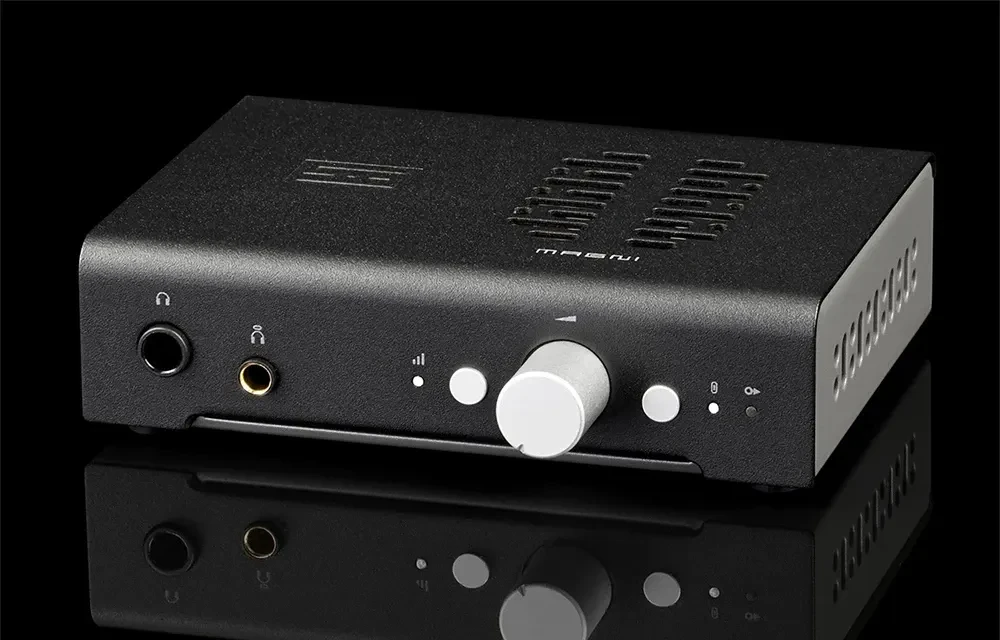
Kopfhörerverstärker
Schiit Audio Magni 6

Kopfhörerverstärker
Schiit Audio Jotunheim 3

Kopfhörerverstärker
Schiit Audio MJOLNIR

Kopfhörerverstärker
Schiit Audio LYR

Kopfhörerverstärker
Schiit Audio JOTUNHEIM