

CD-/SACD-Player und Transporte - TEAC VRDS-701T
Beschreibung, Bilder, technische Daten und Spezifikationen
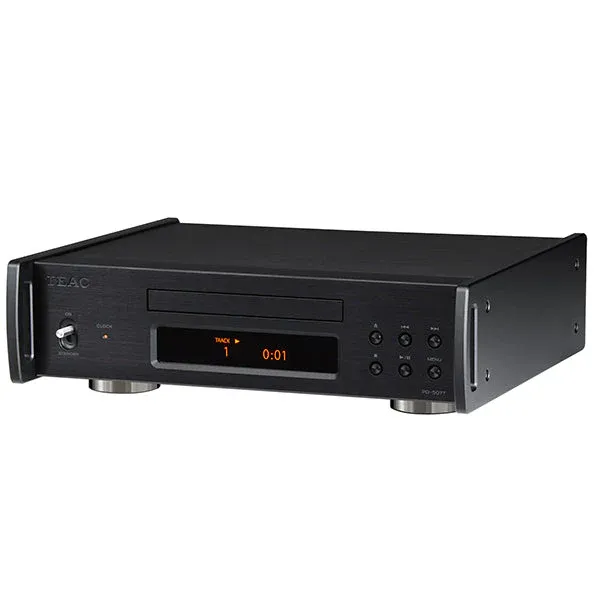
TEAC VRDS-701T
Bildquelle - (c) TEAC
Key specs that matter
Supported media are Audio CD and CD-R/CD-RW, while 8 cm CDs are not supported. Digital outputs are one coaxial RCA (0.5 Vp-p, 75 ohms) and one optical TOS (JEITA RC5720C). A BNC clock sync input accepts 10 MHz at 50 ohms, either as a rectangle wave at TTL level or as a 0.5 - 1.0 Vrms sine wave. MQA CDs are output digitally at 88.2 kHz by a built-in MQA core decoder. Two 3.5 mm mono mini jacks serve as 12 V TRIGGER IN (12 V, 1 mA) and 12 V TRIGGER THRU (maximum current supply 100 mA), and an RS-232C port is provided for control systems. Power consumption is 10 W (standby 0.4 W). Dimensions are 444 x 111 x 333 mm (W x H x D, including protrusions), and weight is 10.1 kg.
Engineering and use context
TEAC started from a drive with a long record in professional applications and added its VRDS technologies. In VRDS the CD is clamped to an aluminium turntable of the same diameter, and the added inertial mass stabilises rotation and reduces vibration of the disc and the mechanism. Correcting disc warping improves the optical axis precision between the pickup and the pit side, so servo current and reading errors are reduced. The bridge supporting the turntable is a resin part with a torus structure, fixed on one side only to suppress vibration travelling across to the opposite side.
Below it, the entire CD mechanism is mounted on the sub-chassis in a semi-floating state. This isolates motor vibration from the main chassis and the mechanism from external vibration. With the DAC function removed, the internal circuitry is optimised for digital output and uses larger components. Two independent high-capacity toroidal core transformers supply the digital control section and the CD mechanism. Both are mounted on a floating structure isolated from the bottom panel. Each side fin for heat dissipation has a different length, and circuit board screws are kept to a minimum. Three machined steel pinpoint feet have a deliberate amount of play in their connection to the bottom panel.
Pairing
A DAC with a coaxial or optical S/PDIF input is required. Full MQA decoding requires a DAC with an MQA rendering function. The matching converter in TEAC's Reference 700 series is the UD-701N. A 10 MHz clock connection allows the whole system to run from one clock generator.
Alternatives
The PD-507T is a CD transport from TEAC's Reference 500 series.
Spezifikationen
Modellbezeichnung
VRDS-701T
Transport
Ja
Player
Ja
SACD-Unterstützung
k. A.
Wandlerchip
N/A
Untere Grenzfrequenz +/- 3dB (CD) (Hz)
N/A
Obere Grenzfrequenz +/- 3dB (CD) (Hz)
N/A
Untere Grenzfrequenz +/- 3dB (SACD) (Hz)
N/A
Obere Grenzfrequenz +/- 3dB (SACD) (Hz)
N/A
Verstärkung (dBu)
N/A
Ausgangspegel (symmetrisch) (V)
N/A
Ausgangspegel (unsymmetrisch) (V)
N/A
Eingangsimpedanz (symmetrisch) (Ω)
N/A
Eingangsimpedanz (unsymmetrisch) (Ω)
N/A
Ausgangsimpedanz (symmetrisch) (Ω)
N/A
Ausgangsimpedanz (unsymmetrisch) (Ω)
N/A
Dynamikumfang (CD) (dB)
N/A
Dynamikumfang (SACD) (dB)
N/A
Signal-Rausch-Abstand (CD) (dB)
N/A
Signal-Rausch-Abstand (SACD) (dB)
N/A
Klirrfaktor + Rauschen (CD) (%)
N/A
Klirrfaktor + Rauschen (SACD) (%)
N/A
Abmessungen (mm)
444 × 111 × 333
Gewicht (kg)
10.1
Offizieller Link
Weitere Komponenten
CD-/SACD-Player und Transporte
TEAC PD-507T

CD-/SACD-Player und Transporte
TEAC PD-301-X

CD-/SACD-Player und Transporte
TEAC PD-505T

CD-/SACD-Player und Transporte
TEAC VRDS-701