
Alle

Standlautsprecher - Sphinx Element 5
Beschreibung, Bilder, technische Daten und Spezifikationen
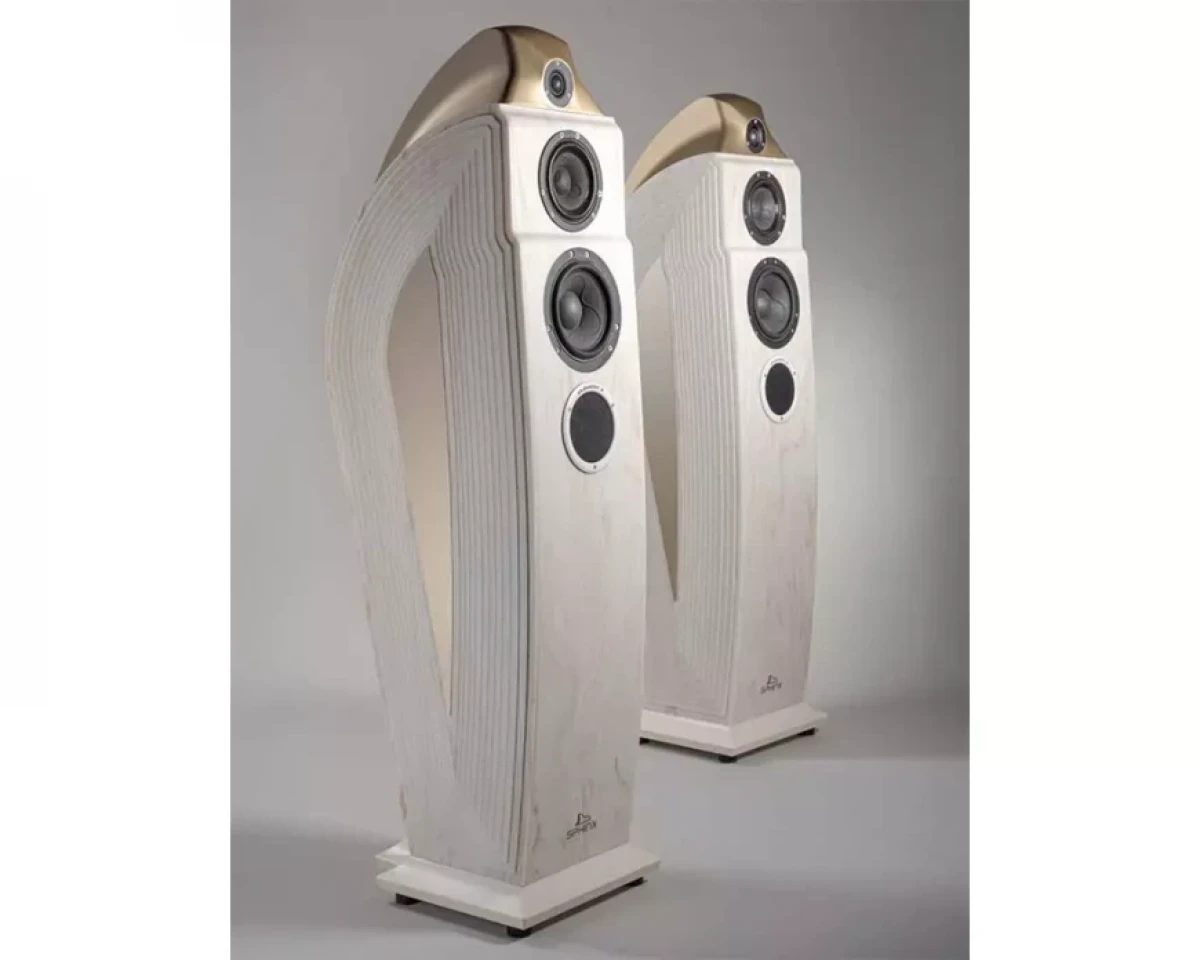
Sphinx Element 5
Bildquelle - (c) Sphinx
The Element 5 is a three-way floorstanding loudspeaker from Sphinx Audio Engineering and the larger of the two models in the Element Series, above the Element 3. Sphinx belongs to the Siltech Group (International Audio Holding) in Elst, the Netherlands, which also owns Siltech and Crystal Cable, and the Element Series marks the relaunch of the Sphinx name. Every Element 5 is hand-assembled and acoustically tuned in the Netherlands.
Key specs that matter
Configuration is 3-way. Bass is loaded by a hybrid non-compression cabinet, the midrange sits in two ported diffusion chambers and the tweeter in a sealed chamber. Sensitivity is 95 dB - 1 W (2.83 V) at 1 m. Impedance is 16 ohms nominal, 14 ohms minimum at 20 kHz and 17 ohms maximum at 20 Hz. Frequency response is 22 Hz (f10) - 40 kHz, or 33 Hz - 40 kHz (±3 dB). THD is less than 0.5%. Sphinx recommends at least 60 W per channel into 16 ohms from a tube amplifier, or at least 150 W per channel into 8 ohms (75 W into 16 ohms) from a solid-state or digital amplifier. Each cabinet weighs 66.2 kg and measures 282 x 425 x 1356 mm (W x D x H).
Engineering and use context
Two woofers are mounted back-to-back in a force-cancelling arrangement and work with a dual-channel transmission-line structure that Sphinx calls Zero Gravity Bass. Instead of trapping and damping the rear wave, this channel delays it and aligns it in phase. Above the bass section, two midrange chambers and a 29 mm beryllium dome tweeter form an MTM configuration, with the tweeter in its own time-aligned housing on top. Internal wiring is Silver-Gold.
The crossover is the PAC hybrid network, which Sphinx describes as a passive-interface, amplifier-assisted system. A balanced, low-impedance RC crossover without inductors operates in the analogue domain at low power, followed by local buffer stages with band-specific gain and dedicated Class D power modules for the drivers. To the external amplifier the Element 5 is a standard passive 16 ohm load, and the signal chain of source, preamplifier, power amplifier and loudspeaker stays the same. A +3 dB woofer switch changes gain in the woofer buffer stage only. The stone-like cabinet exterior is shaped after the silhouette of a harp and stands on a curved aluminium base for stability and heat dissipation.
Pairing
A conventional stereo or mono power amplifier with speaker outputs is required. With a tube amplifier the 16 ohm output taps are the matching connection.
Alternatives
The Sphinx Element 3 is the smaller model of the series, with a 150 mm woofer, a 120 mm midrange and the same 16 ohm nominal impedance.
Spezifikationen
Modellbezeichnung
Element 5
Untere Grenzfrequenz +/- 3dB (Hz)
19
Obere Grenzfrequenz +/- 3dB (Hz)
39000
Empfindlichkeit (dB at 1 W/1m)
95
Impedanz (Ohms)
N/A
Anforderungen an den Endverstärker (W)
N/A
Verfügt über interne Verstärkung
k. A.
Leistung der internen Verstärkung (W)
40 - 50
Größe (sm)
N/A
Gewicht (kg)
N/A
Offizieller Link
Weitere Komponenten
Standlautsprecher
Sphinx Element 3